Small Room, Open Hall: What Different Venues Invite
Small room versus open hall: see how venue layout shapes attention, movement and audience connection, so you can choose spaces that suit the music.

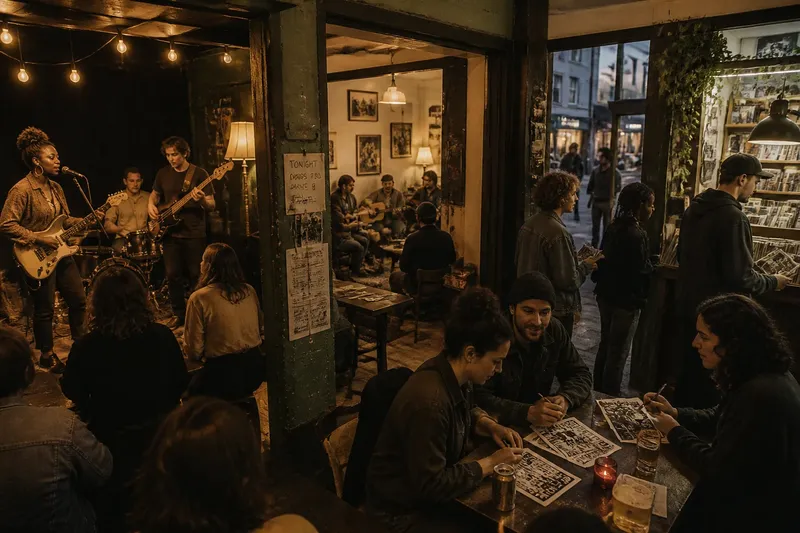
A small room makes a singer’s breath, a drummer’s brushwork and a listener’s stillness feel close; an open hall gives bodies room to shift, gather and spread. The difference between a small room and an open hall is not simply capacity. Each setting invites a different kind of attention, and understanding that invitation helps performers, promoters and audiences read a night on its own terms.
These are tendencies, not rules. A crowded hall can feel intimate; a compact room can be restless. Sound, lighting, stage position and the habits of the people in the space all matter. But the shape of a venue quietly influences what feels natural: where people look, how they move and how readily they notice one another.
Proximity changes attention
In a close room, the performer’s face and hands are easy to see. A pause between songs can feel like a shared breath rather than a gap to fill. Small musical details—fingers sliding along strings, a player leaning towards a bandmate, a soft harmony—may hold attention because listeners are physically near enough to catch them.
That closeness can make audience response feel immediate. A laugh, a nod or a hush travels visibly across the room, and performers may adjust their phrasing or patter in response. The exchange need not involve speaking. A quiet audience can be active in its attention, while a lively one can answer a musical gesture with a ripple of movement.
Open space alters the scale of looking. From the back or side of a hall, a listener may see the whole ensemble but miss a player’s expression. The eye can move among the stage, the room and other listeners. This broader view often suits music with layered parts or a strong visual arrangement, where the pattern of the whole group matters as much as a single face.
For performers, the practical question is what should remain visible and audible from different positions. A subtle vocal exchange may need a clear sightline; a rhythmic change may need a firm sound that reaches beyond the front rows. Let the arrangement suit the distance rather than assuming every room rewards the same kind of detail.
Space shapes movement
Movement in a small venue is often negotiated in close quarters. A listener may sway in place, turn sideways to let someone pass or leave a clear route to the door. When a performance depends on restraint, that contained movement can help the room settle. When the music asks for dancing, limited floor space can concentrate the energy, though it may also leave some people preferring the edges.
An open hall offers more possible paths. People can dance near the front, listen from a quieter side, stand with friends further back or move between those positions. That freedom can make a night feel less like a single audience facing one fixed point. It can also mean the room’s attention is distributed: the band plays to a crowd with several pockets of activity rather than one tightly gathered group.
The floor plan gives those choices shape. A central support pillar can split sightlines; a bar beside the stage can draw conversation into the listening area; chairs placed in a broad block can make walking through feel awkward. A venue’s usable space is therefore not just its bare floor. It is the routes, clear views and comfortable places to pause that remain once equipment and furniture are in position.
Imagine a folk trio booked into a broad hall with a low platform and chairs arranged in narrow rows. If the organiser leaves a clear side route and a small open area near the front, listeners can choose between seated attention and gentle movement without crossing the main view. The likely result is a room with more than one comfortable way to take part, not a promise that everyone will respond in the same fashion.
Distance has a sound
Room size affects how sound reaches a listener, but dimensions alone do not predict the experience. Hard walls can send reflections back into the room; soft furnishings and a crowd can absorb some of that energy. A low ceiling, an irregular shape or a stage tucked into a corner may influence clarity as much as the overall footprint.
In a small room, a quiet instrument can sit close to the audience without being swallowed by the surroundings. Yet the same closeness can make a loud source feel forceful, particularly for listeners near a speaker. In a hall, sound has more space to travel and may blend into a wider image. That can flatter a full band, while a delicate vocal or acoustic part may need careful placement to remain intelligible throughout the room.
Listening positions matter. The sound at the front may differ from what reaches the back wall or a side alcove. Before doors open, a performer or sound operator can listen from more than one part of the venue and notice whether a vocal disappears, percussion dominates or conversation gathers in an unhelpful spot. For an audience member, moving a little can be a simple way to find a clearer balance.
Room acoustics, safe capacity, access arrangements and equipment limits depend on the venue and applicable local requirements. For event decisions, check the venue’s own information and seek qualified advice where technical or safety matters require it.
Connection takes different forms
Audience connection is not measured only by how close people stand to the stage. In an intimate room, it may appear as sustained attention, a shared laugh or a singer noticing a listener’s response. In an open hall, it may emerge through collective movement, a chorus carried by many voices or the sight of one group encouraging another to join in.
Neither form is automatically deeper. A person who prefers to watch quietly may feel more connected from the edge of a large room than from a packed space where every movement is visible. Someone else may value the warmth of being close enough to recognise each performer’s gestures. The room can invite participation, but it cannot dictate what participation means to each listener.
Performers can help by making the invitation legible. In a small room, a direct look or a brief introduction may be enough to bring listeners into a song’s quieter turn. In a hall, a clear visual cue—a raised hand before a chorus, for instance—can reach people who are further away. The point is not to demand a response, but to make the music’s shifts easy to follow across the space.
Promoters can think beyond the stage as well. A welcoming entrance, a place to sit away from the main sound and a route that does not cut through the performance area all affect whether people can choose how close to be. Those details make room for different ways of listening without turning audience connection into a test of enthusiasm.
Choosing a room?
What suits quiet, detailed music?
A small room can make delicate phrasing and subtle instrumental exchanges easier to notice, especially when sightlines are clear. A larger space can also work if the sound carries cleanly and the arrangement gives listeners a clear thread to follow.
Does a bigger hall mean more dancing?
Not by itself. Open floor area gives people more room to move, but furniture, entrances, sound levels and the event’s atmosphere all influence whether they use it.
Can an intimate set work in a large venue?
Yes, if the performance gives distant listeners something to follow, through clear sound, visible gestures or a thoughtful stage arrangement. A smaller audience gathered near the front can also change the feel of a broad hall.
How can listeners choose where to stand?
Look for a position that suits the way you want to listen: close enough to catch detail, farther back for a view of the whole ensemble, or near an edge if you want room to move. If the sound feels unbalanced, try another listening position rather than assuming the whole venue sounds the same.
Read the room
Choosing between a small room and an open hall is really a choice about the kind of attention a performance can hold and the ways its audience can occupy the space. Close rooms often make individual gestures and immediate response prominent; larger halls make broad movement, changing viewpoints and collective energy easier to accommodate. A good match depends on the music, the layout and the people who will use it.
Before settling on a venue, picture the audience arriving, finding a place, listening and leaving without blocking one another. Then consider what the performance asks them to notice. That small act of imagination can reveal whether the room’s invitation fits the night—and where a simple change in arrangement might help the music meet its listeners.