The Shared Decisions Behind a Collaborative Set
Plan a collaborative set with clear roles, agreed transitions and a common direction, so musicians can listen closely and make room for one another on stage.
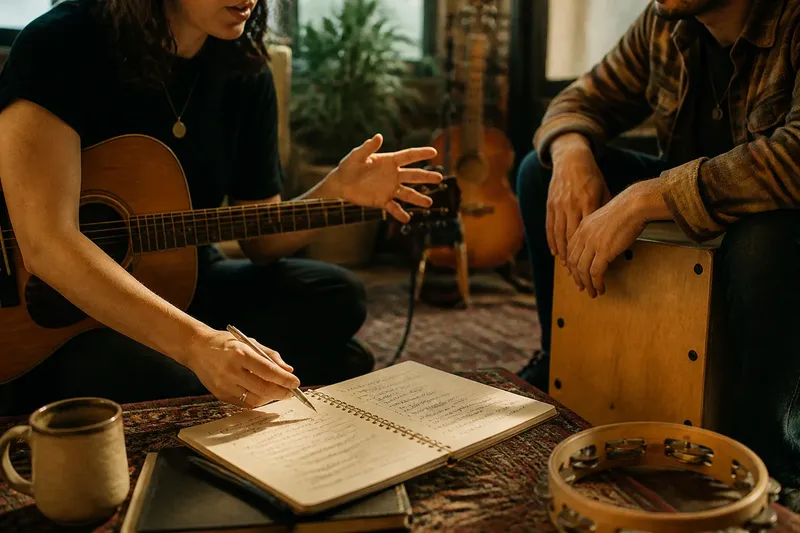
A collaborative set works best when everyone knows what they are responsible for—and what they are free to change. Before a shared performance, musicians can agree on roles, transitions and a common direction without scripting away the alertness that makes playing together feel alive. The conversation is part of the music: it gives each person a place to begin, and enough room to respond.
That matters whether a group is bringing together regular bandmates, guests from another act or players who have only just met. The aim is not to settle every note. It is to make the important decisions visible, so an unexpected musical idea feels like an invitation rather than a collision.
Start with the purpose
Before choosing songs or assigning parts, agree on what the performance is meant to be. A shared bill might call for a compact meeting of two groups’ sounds; a benefit or community gathering might suit a looser, welcoming atmosphere. Put the intention into plain language. “We want the audience to hear how these vocal styles answer each other” gives the group something more useful to act on than “Let’s make it special.”
Invite each musician to name one thing they hope the set will make possible. One person may want a song to open up into an instrumental passage; another may want to keep the set rooted in a particular rhythm or lyrical mood. These wishes can coexist, but only if they are spoken before the group has invested in a direction that leaves someone out.
Then check the practical boundary around the performance: how much playing time is available, whether the appearance has a particular theme, and whether the collaborators are expected to share the stage throughout or take turns. Treat those facts as the frame, not as artistic decisions made on someone’s behalf.
Map the musical ground
Next, choose material that can carry the agreed intention. Familiar songs are not automatically easier: different musicians may know different arrangements, lyrics or endings. Original material can be more flexible, but it still needs a shared understanding of its shape. For each candidate, ask what everyone already knows and what would need to be learned.
Lay the possible pieces out in performance order, even if the order is provisional. Consider how one gives way to the next: a reflective song after a busy one may create contrast, while two pieces with similar energy can make a continuous passage. The sequence should have a reason listeners can feel, even if nobody explains it from the stage.
Keep a clear distinction between a fixed feature and an open invitation. A repeated refrain might be fixed so every singer can find it; a middle passage might be open to a solo, a vocal response or a gradual return to the main pattern. When the group names that difference, musicians can take creative chances without guessing whether they have broken an agreement.
Assign the listening roles
Roles are more useful when they describe a responsibility, not a rank. One musician might lead the opening and cue the first change. Another might hold the rhythmic centre while a guest singer takes the melody. A third could watch for the agreed ending signal. These jobs give the group a workable shape while leaving room for people to contribute ideas outside their main part.
Ask each player what they feel comfortable carrying. A person who enjoys initiating may welcome the opening cue; someone who prefers to listen may be better placed to support a vocal entrance or notice when the group is ready to move on. Do not assume the loudest or most experienced musician should direct every moment. The best person to lead a passage is the one the others can read and trust in that passage.
Agree, too, on how a musician can signal a change of plan. A brief look, a raised hand or a spoken cue may work, provided the whole group knows what it means. Keep the signal simple enough to notice while playing. If a cue has several possible meanings, clarify them in conversation rather than hoping everyone will interpret it alike.
Say you are bringing together a singer-songwriter and a percussionist for a short shared performance. They might agree that the singer begins alone, the percussionist joins on a clear gesture, and both leave the final refrain open for a slower ending if they meet each other’s eye. That small arrangement makes the entrance and ending legible while allowing the middle to breathe.
Set the transitions
Transitions are where a collaborative set can feel joined up—or suddenly uncertain. Decide whether each change will happen through a clean pause, a spoken introduction, a continuing rhythm or a brief musical bridge. The right choice depends on the material and the atmosphere; not every gap needs to be filled.
For each transition, establish three things: who begins the next moment, what other musicians do while it starts, and how the group knows the new section has arrived. A bridge led by one musician might need everyone else to stay quiet until a familiar phrase returns. A spoken introduction might need the others to hold their places rather than begin tuning or talking over it.
Pay particular attention to endings. “Finish together” can mean different things to different players. Agree whether the last passage repeats, whether the volume or intensity changes, and who gives the closing cue. If a song has more than one plausible ending, name the one the group will use for this performance.
Leave a pause where a pause serves the set. A deliberate silence lets a lyric settle or gives the audience a moment to respond. The point is not to make every transition smooth; it is to make each one purposeful enough that performers are not left waiting for someone else to decide.
Choose a common direction
A common direction is a set of shared principles, not a demand that every musician sound alike. Agree on the qualities the performance should protect: perhaps the lyrics stay easy to hear, guest voices have space, or changes in energy feel gradual. Then let players interpret those principles through their own musical language.
It can help to discuss what the set should avoid. The group may decide not to turn every song into a jam, not to layer harmonies over a particularly exposed lyric, or not to extend a passage unless the musicians make an unmistakable invitation. A boundary can be freeing: everyone knows which possibilities are welcome and which would pull the performance away from its centre.
Be specific about collaboration. “Make room for each other” is a generous intention, but it can be hard to act on in the moment. Translate it into choices: leave the first verse to one voice, answer with harmony on the refrain, and give the instrumental break to a different player. These agreements help participation feel audible rather than merely announced.
What should you agree before playing?
How much should a collaborative set be rehearsed?
Rehearse the parts where uncertainty could interrupt the performance: entrances, changes between songs, exposed hand-offs and endings. Leave passages that are meant to be open genuinely open, rather than polishing away their purpose.
Who should lead a transition?
Choose one person whose cue the others can recognise, and make clear what that cue starts. Leadership can move from one musician to another across the set; it does not have to belong to the same person throughout.
What if musicians disagree about an arrangement?
Return to the set’s agreed purpose and ask which arrangement best serves it. If both ideas have merit, try them in rehearsal and choose one for the performance, leaving the other for a later collaboration rather than settling the question by force of personality.
How can players leave room for improvisation?
Mark the passage where improvisation is welcome, identify how it begins and decide how the group returns to the planned material. That frame lets a player take a musical risk without making everyone else guess how long it will last.
Rehearse the agreements
Once the group has a plan, play the set in order and listen for moments when the plan disappears in practice. A transition that sounded obvious in conversation may be unclear once the music is moving. Stop, name the problem without assigning blame, and adjust the cue or responsibility.
Use rehearsal to check whether each role is audible and comfortable. If a singer cannot hear the response that is meant to guide their entrance, change the arrangement or the signal. If one player is carrying too many cues, share the work. Rehearsal is a place to find where the group needs greater clarity, not a reason to make every detail rigid.
Give each musician a chance to describe what they think the plan is. A short recap can reveal mismatched assumptions: one person may expect a solo to finish at their discretion, while everyone else expects a fixed return to the refrain. Correcting that misunderstanding before the performance is kinder than discovering it on stage.
Keep the plan generous
Before the set, agree how to handle a missed cue or an unexpected change. The most useful response is usually to keep listening, follow the person who is clearly leading and rejoin at a recognisable point. Avoid treating a small deviation as a crisis; a collaborative performance can recover when its members stay attentive rather than competing to restore control.
Afterwards, talk about what the collaboration made possible. Name a transition that felt natural, an entrance that could be clearer next time or a musical exchange worth developing. Keep the discussion about choices and shared experience, rather than turning it into a verdict on individual musicians.
A collaborative set grows stronger when its agreements support curiosity. Decide who begins, how the music changes direction and where players may surprise one another; then leave enough space for the performance to answer back. That balance is the practical heart of planning a collaborative set: clear enough to share, open enough to belong to everyone.