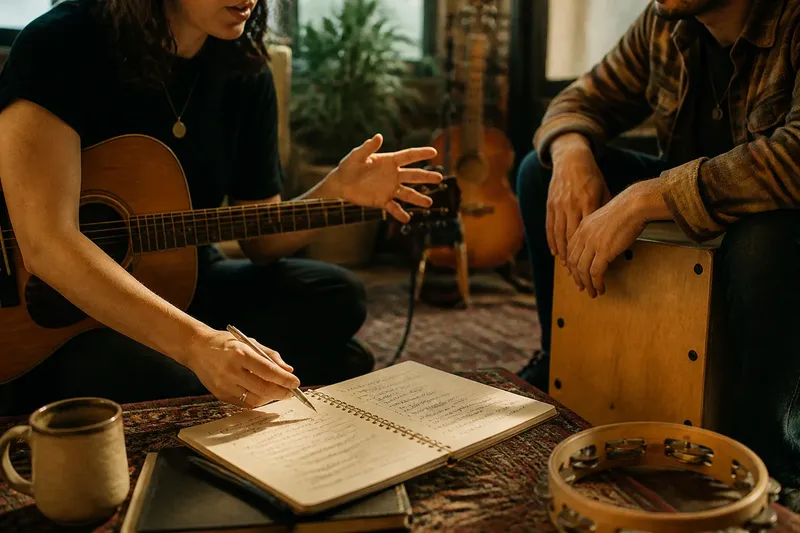
Your First Visit to a Community Music Gathering
A first visit to a community music gathering can feel easier with a simple plan: choose what to notice, find a comfortable place and listen on your terms.

Your first visit to a community music gathering need not include a performance, a conversation or even staying until the end. A community music gathering can mean a singaround, an open rehearsal, an informal jam, a listening circle or a neighbourhood music night; the useful first decision is what you want from this particular visit. Pick one thing to notice, then give yourself permission to listen quietly.
That small aim can take the pressure out of an unfamiliar room. You are not there to prove that you belong. You are there to see what the gathering is like and whether its sounds, pace and customs suit you. The plan below sorts common situations by what tends to help, while leaving room for each group to do things its own way.
Choose your first aim
Before setting off, name one manageable reason for going. A narrow aim gives your attention somewhere to rest when you are unsure what to do next.
- If you want to understand the music: listen for how the instruments or voices respond to one another. Notice a repeated rhythm, a change in volume or a melody that returns.
- If you want to know the room: watch how people enter, where they sit and whether there is a host who explains the format.
- If you want to meet someone: aim for one brief exchange, perhaps with the person welcoming arrivals. There is no need to work the whole room.
- If you are curious about joining later: observe how invitations happen and whether newcomers are given a clear way to take part.
Say you are interested in a local folk singaround but do not know the songs. Your aim could be to listen for how the group signals a chorus. That gives you something specific to follow without making singing the price of admission.
Match the gathering
Different formats ask different things of visitors. A little information beforehand can help you choose a first occasion that feels legible rather than demanding. Read the event description, look for a contact person and check whether the gathering welcomes listeners as well as participants.
For quiet listening
Look for a concert-style community event, a listening circle or an advertised open rehearsal with space for observers. These settings often make it easier to settle in without being expected to take a turn. If the description is vague, a short message to the organiser can clarify whether visitors may simply listen.
For gentle social contact
A hosted music night or a community sing may offer a natural first conversation: ask about the programme, a tune or how the evening is organised. A welcome desk, printed song sheet or short introduction can give you an easy opening. Choose a gathering where someone is visibly responsible for greeting people if arriving alone feels awkward.
For possible participation
An open jam, participatory singing group or workshop may suit you if you want to try something eventually. Check how turns are offered, whether there is a beginner-friendly section and whether bringing an instrument is expected. You can still attend once as a listener before deciding whether to join.
Read the event’s own description and follow any stated access, venue or participation arrangements; if an essential detail is unclear, ask the organiser before you travel.
Settle in quietly
On arrival, give yourself a moment to read the room. Find the host or a sign-in point if there is one, and ask a simple question such as, “Is it all right to sit and listen tonight?” A direct question is often easier than trying to infer an unwritten custom from across the room.
Choose a place that lets you hear comfortably without blocking a doorway, performer or shared passage. You do not need to sit at the front to show interest. If the room is busy or sound is intense, move to a quieter spot or step outside for a pause when that is possible.
Keep your first visit easy to adjust. Arrive in time to hear the welcome if you can, but do not treat a late arrival as a reason to turn back. If you need to leave early, a quiet exit between songs or sets is usually less disruptive than leaving in the middle of a performance.
Listen without performing
Listening is an active way to take part in shared music. You can follow the pulse, notice who leads a transition or attend to how a room responds when a tune changes. No one needs to see you doing it. Keeping your phone away and giving performers your attention is already a clear contribution.
Not every gathering treats silence, applause or conversation in the same way. Some groups welcome clapping and singing along; others concentrate on the music between introductions. Watch what people do, and if you are unsure, follow the host’s cues. You can also ask before joining a chorus or adding an instrument.
It is fine to pass when someone invites you to play or sing. A warm “I’m listening tonight, thanks” is enough. If an invitation feels unclear, ask whether there is a particular tune, order or way of joining. That lets you decide with useful context rather than guessing under pressure.
When should you join in?
What if I do not know the songs?
Stay with the listening aim you chose, and notice whether a refrain repeats or a song sheet is available. If the group invites everyone to join, you can hum, follow the words or simply listen; none of those choices requires an explanation.
What if I arrive alone?
Ask the host where visitors usually sit, or choose a place near the edge where you can settle without feeling on display. One friendly exchange is plenty for a first visit, and a quiet evening can still be a successful one.
What if someone asks me to perform?
You may decline without offering a reason: “Not tonight, thank you” is clear and courteous. If you are interested but not ready, ask whether you can watch this time and learn how the group handles turns.
How do I know whether to return?
Notice what stayed with you afterwards: a sound, a welcome, the way the gathering was run or how comfortable you felt as a listener. If one part appealed and another did not, look for a different format from the same community rather than assuming every event follows the same customs.
Leave with a next choice
Afterwards, make a brief note on your phone or in a notebook: what you enjoyed, what felt confusing and what you might want to try next time. Keep it descriptive, not a verdict on yourself. “The room was lively; I liked following the bass; I would prefer a quieter seat” is more useful than “I was bad at being sociable.”
If you want to return, check the next event’s format rather than assuming it will be identical. A group may alternate between listening nights, workshops and open sessions. You might choose another listening visit, ask the organiser about a beginner-friendly occasion or bring an instrument only when you feel ready.
Your first visit to a community music gathering is allowed to be just a visit. Choose one thing to notice, find a place where you can listen comfortably and let curiosity set the pace. If you leave knowing what kind of music or welcome you would seek next, you have already made a useful connection to the local musical life.